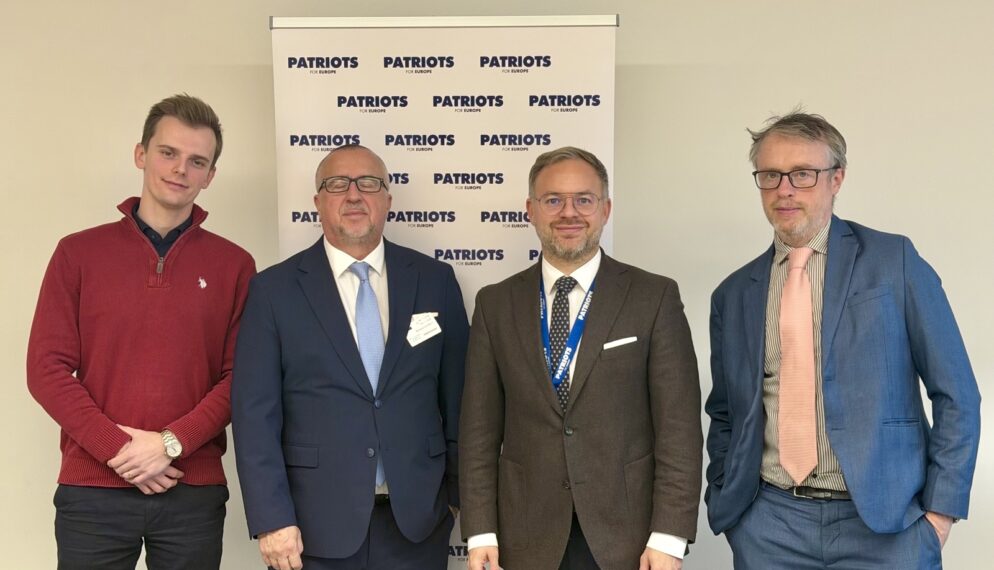
CONFERENCE PHOTO
Brussels does not want democracy, but obedient governments
2026. 11. 04.
Balázs Orbán, Fidesz–KDNP MEP and member of the Patriots for Europe group, spoke at the “EU Uncensored – The Making of a European Empire” conference held at the European Parliament, addressing current electoral trends and the relationship between the exercise of political power in Europe and media freedom. The MEP highlighted that while Hungary set an example through its family policy under Viktor Orbán, under Péter Magyar, with Brussels’ approval, liberal authoritarianism could become Hungary’s new export model. International journalists and public figures also shared their experiences and views on current issues surrounding the European public sphere and political communication.
Ed West, British journalist and author, highlighted the political consequences of social discontent, pointing out that although political elites may try to address problems through communication, voters judge based on their own experiences, and genuine dissatisfaction cannot be eliminated simply by shaping political narratives.
Richard Schmitt, Austrian journalist and former editor-in-chief of Exxpress, warned that freedom of speech in Europe is increasingly under threat, often through indirect means, as censorship no longer necessarily takes the form of outright bans. State regulation, pressure on digital platforms and discrimination against politically unwelcome opinions are increasingly narrowing the space for open public debate. As a result, positions that differ from the political mainstream can easily be labelled as disinformation or hate speech. “Democracies rarely collapse because of too much freedom of speech – but the absence of freedom of speech poses a genuine threat to them,” he said.
Roan Asselman, Belgian journalist and political commentator, spoke about how the concepts of democracy and left-wing political thinking are increasingly being conflated in Europe. “If you are on the right, you are labelled authoritarian; if you are on the left, you are automatically considered a democrat,” he pointed out, warning of the dangers of applying a double standard in politics. He stressed that this practice also threatens the implementation of voters’ will, as efforts are made to prevent democratically elected right-wing governments from implementing their policies, paradoxically in the name of protecting democracy.
Michał Karnowski, Polish journalist and commentator, joined the conference online. Drawing parallels between political developments in Poland and Hungary, he warned that, in his view, the aim of liberal authoritarian politics is not merely to win elections, but to permanently marginalise the right-wing opposition and prevent it from returning to power. He stressed that similar political methods are being employed in both countries, making Polish–Hungarian solidarity particularly important in defending democracy and national sovereignty.
One of the central questions addressed at the conference was how social discontent affects the functioning of Western political systems and what challenges democratically elected governments face. In connection with the issues raised by the participants, it can be observed that protest votes driven by dissatisfaction with incumbent governments are playing an increasingly significant role in elections both in Europe and in the United States. However, the electoral mandate gained in this way is extremely fragile: if a new political leadership breaks its campaign promises, it can quickly become the target of public discontent itself. This should also serve as an important warning to Brussels: the foundation of democratic legitimacy is the trust of voters, not whether a political force meets the expectations of EU institutions.